


Before presenting today’s new thesis (a company we hold in our portfolio, unrelated to artificial intelligence (AI), undervalued, and with a hidden asset that could act as a catalyst), we want to share two reflections.
The first is about the keys to portfolio management and how ours held firm this week, closing in positive territory (+1.0%) while the S&P 500 and the Nasdaq 100 fell -2.7% and -5.0%, respectively. The second is about the patience that the new market paradigm we are living through demands.
What you’ll read today
The art of building and maintaining a resilient portfolio
On patience in a new market paradigm
New thesis, FILA: a boring business hiding a hidden asset
1) The art of building and maintaining a resilient portfolio
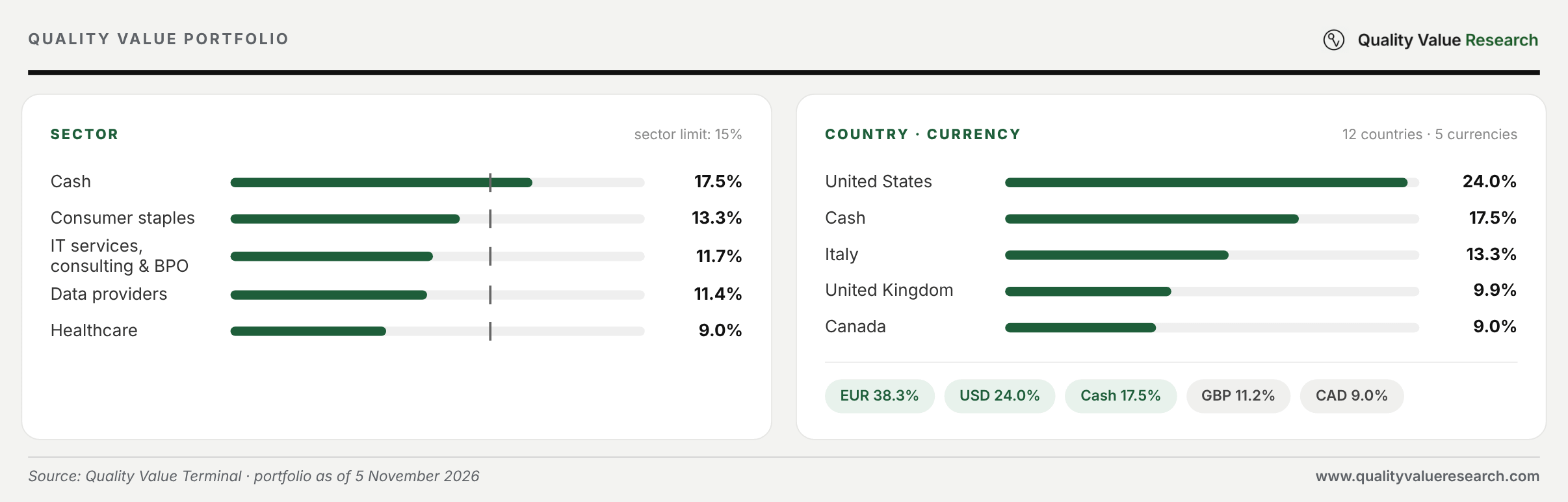
In our view, an equity portfolio should be built and managed with a holistic perspective, where the different positions complement one another. For example, you can hold a bullish thesis on the software sector based on quality and valuation, as we do, and withstand market volatility and uncertainty. But it isn’t wise to have the whole portfolio in a single sector, because then the entire portfolio depends on a single market factor. You may see more opportunities in Europe, but it isn’t wise to be exposed only to Europe either: you also need exposure to other relevant markets, such as the US. Energy is today a key variable for most businesses. When it’s cheap, they benefit; when it isn’t, their margins get squeezed. That’s why it makes sense to have part of the portfolio in energy, complementing the rest of the positions.
Some companies have a lot of potential, but also a very wide range of possible outcomes. You can hold a few of them as spearheads: they tolerate more volatility and can deliver extra returns if the good scenario plays out. But in our view, you can’t build the whole portfolio from this type of stock. They need to be balanced with boring but solid businesses that offer less upside, but more predictability.
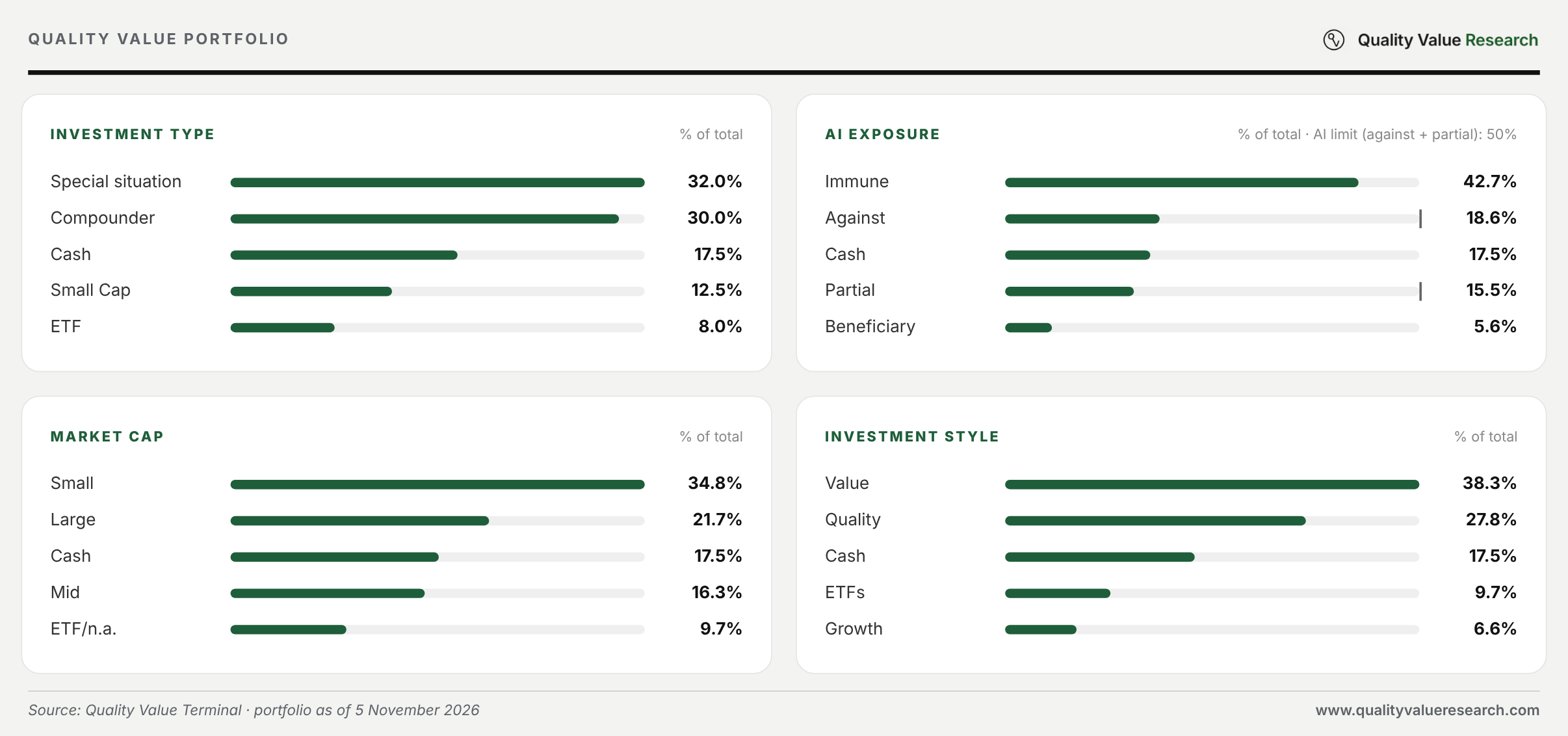
We also believe a solid portfolio needs a backbone of high-quality businesses bought at good prices with a long-term view, whose weights are adjusted according to the return each one offers at its valuation at any given time.
In short, a portfolio should be an all-terrain vehicle that can survive the different economic regimes that may arise:
overweight the businesses that benefit from the current regime;
hold contrarian bets against the current market situation, with limited weights;
a core of quality businesses with predictable futures, trading below their historical average valuations;
boring, predictable and very cheap businesses with a high margin of safety;
and innovative companies with high growth potential, knowing that their range of outcomes is wider.
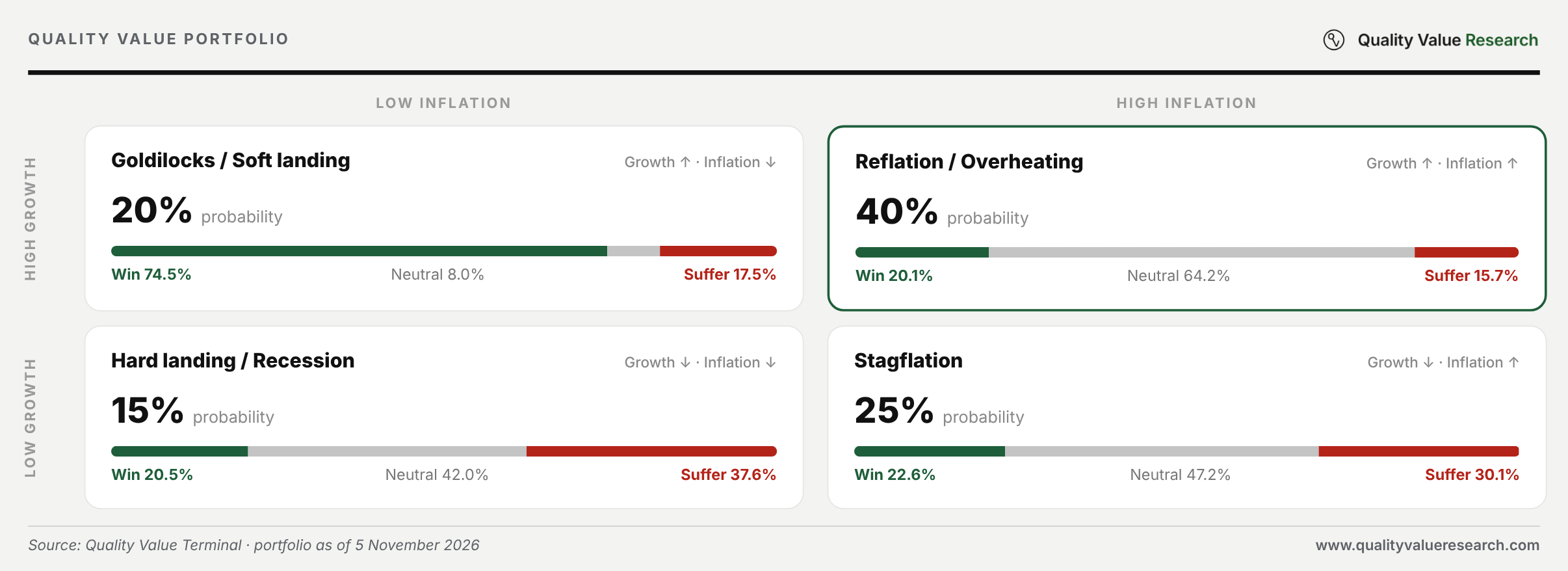
And it should be analyzed, and decisions made, as a whole, looking at how the positions complement each other. That is the art of building a resilient portfolio: when the market falls, part of the portfolio falls too, but the rest holds up, whether because of valuation or because of the contrarian bets.
This is what we have studied and worked on most this year, and it’s starting to show. This week, while the S&P 500 fell 2.7% and the Nasdaq 100 fell 5.0%, our portfolio held firm at +1.0%, precisely because it is diversified and undervalued. That undervaluation is what gives us our margin of safety, which in our view is the most important aspect of any investment.
2) On patience in a new market paradigm
We discussed this recently on the Quality Value podcast with Javier Galán, Head of Equities at Renta 4 Gestora: the market has changed. It used to be driven much more by fundamentals; now flows and passive investing are in charge.
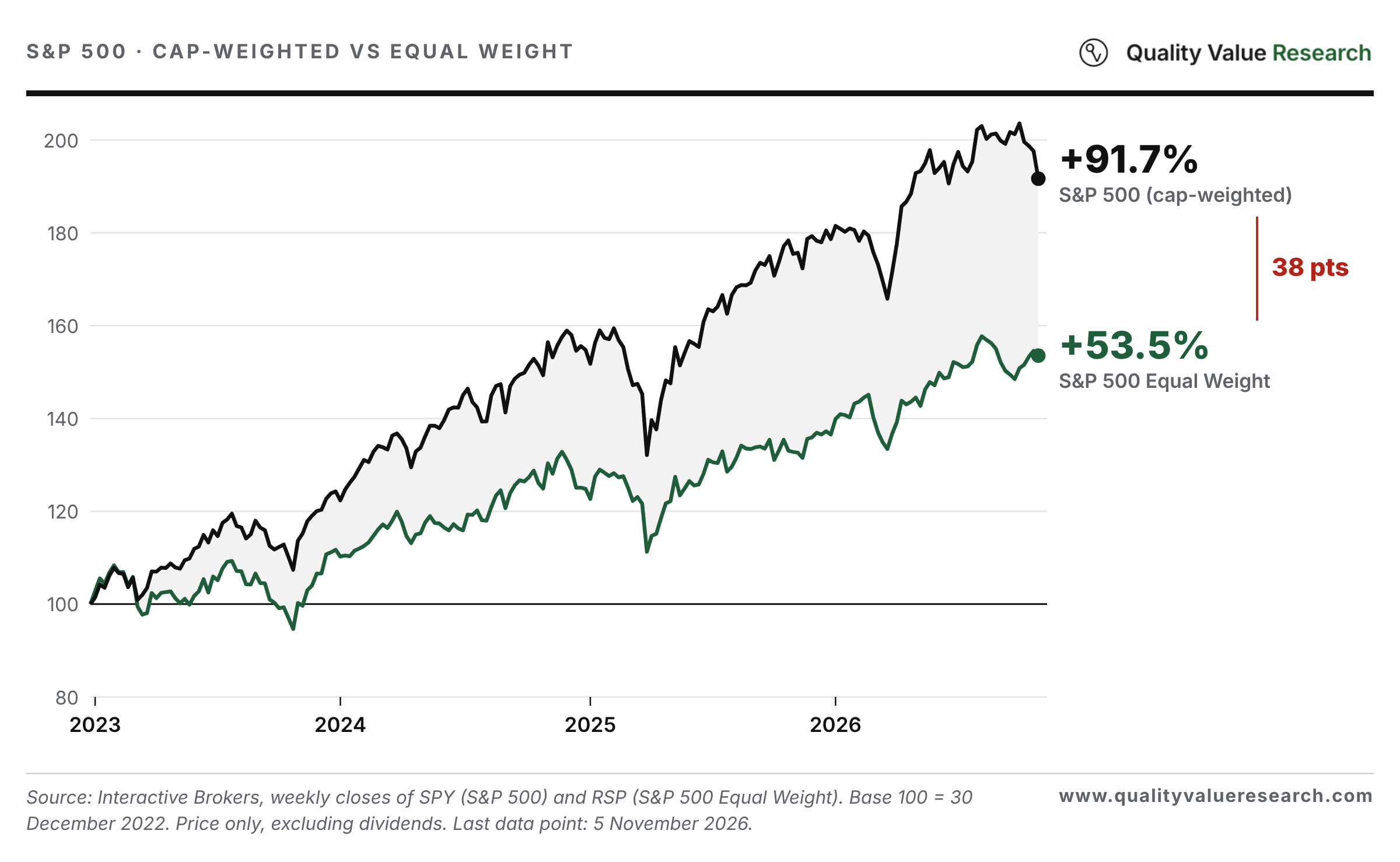
Index funds buy by size. The more a company rises, the more weight it carries in the index and the more money it receives with every new contribution. The one that falls weighs less and receives less. In the past, if a quality company traded at a 30% discount to its historical average, the price would usually converge gradually toward that average, as long as the long-term thesis hadn’t changed. Now, with this mechanism, the result is extreme undervaluations and overvaluations over short periods of 6 to 12 months.
An example: a company trading at 15 times earnings reports 10% growth when 12% was expected, and the stock falls 20%. It can fall even further and, worse, it can stay flat or keep falling for much longer than before, simply because the flows don’t arrive.
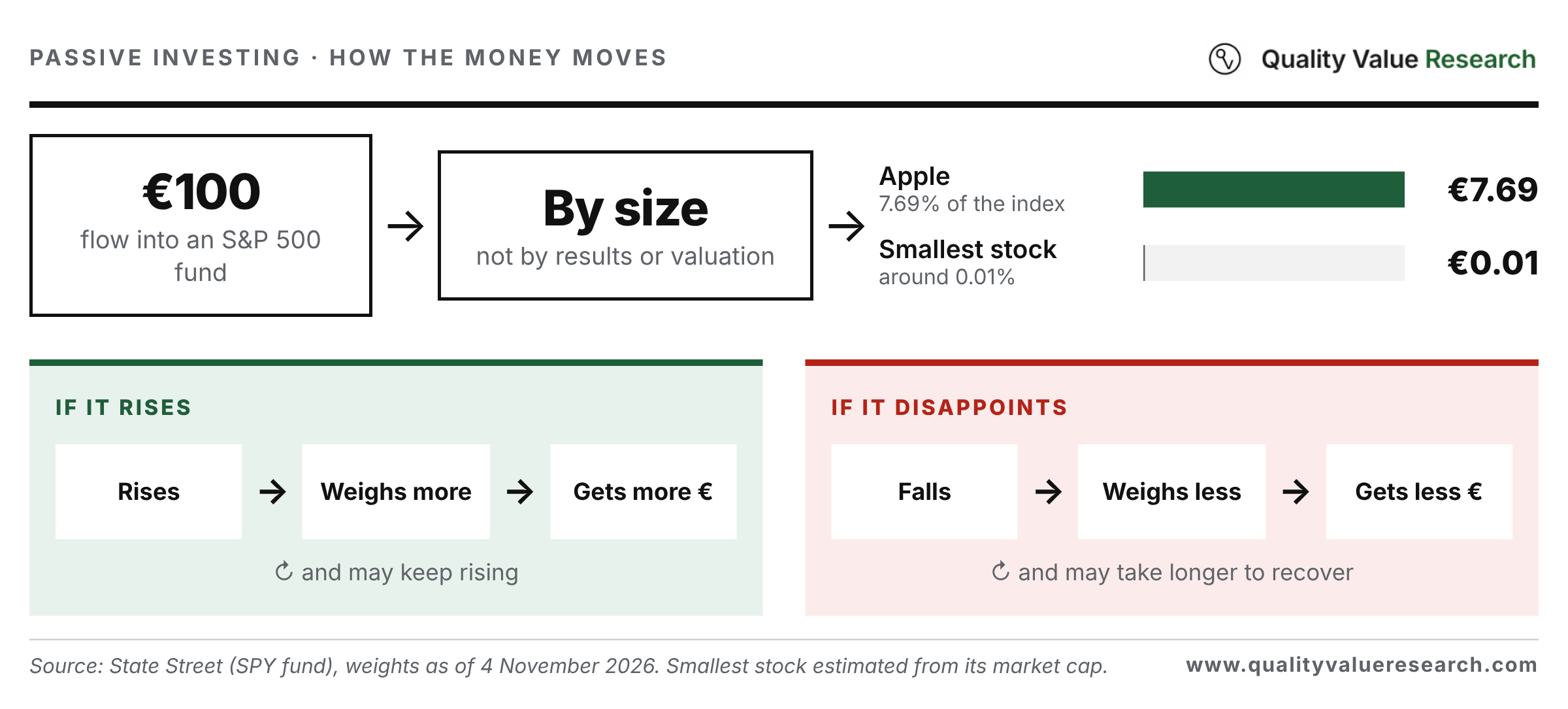
So how do we act if a business we liked at 15 times earnings ends up trading at 8 times for reasons we consider exaggerated or temporary?
With patience: we wait for flows to start coming back, avoid rushing to buy into the decline, and look for a catalyst. That could be the next results, company-specific news or a shift in the market narrative. It’s hard to know where the bottom is, but it usually coincides with the moment when bad news no longer moves the share price. That suggests the market has already priced in all the bad news and only the good is left to collect.
The other option is to buy when the company pays a dividend that compensates for the wait, or when it hides a short- or medium-term catalyst that can unlock value. That limits the waiting time and reduces the opportunity cost.
3) New thesis, FILA: a boring business hiding a highly valuable hidden asset
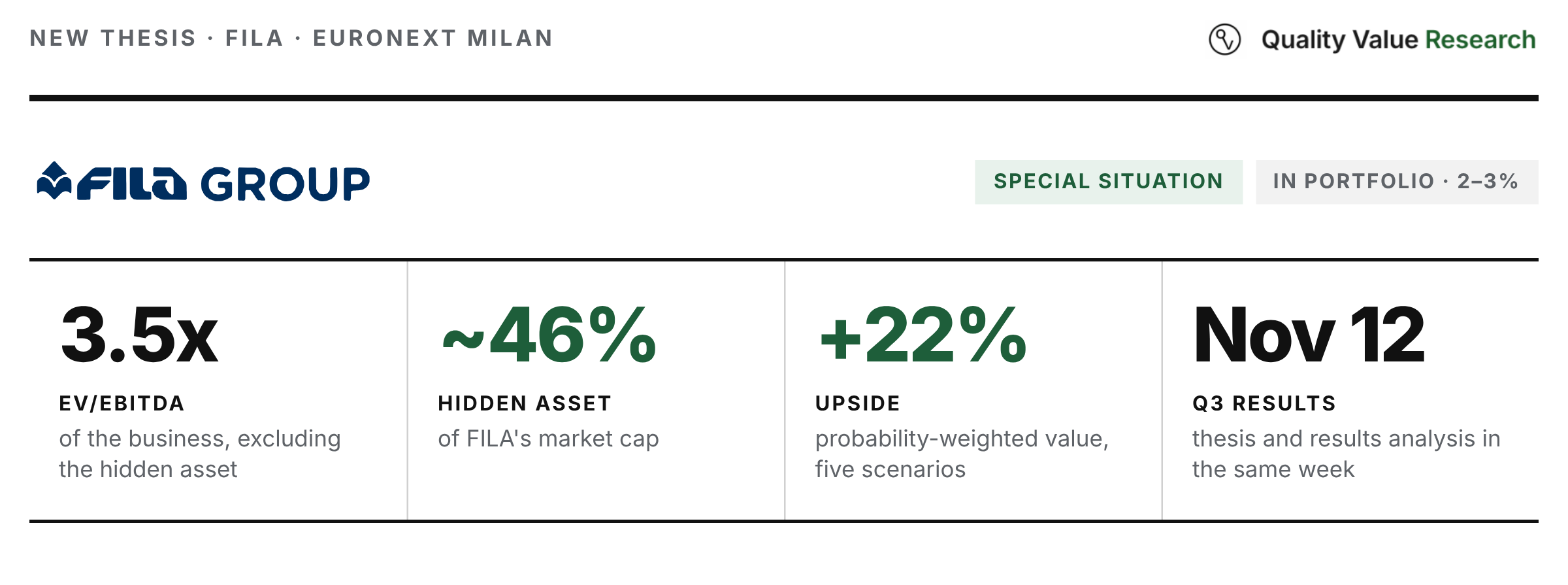
We wanted to frame this thesis with these reflections because it fits them precisely. On one hand, FILA is a boring company. It makes pencils, paints, and school and fine-art supplies under brands such as Giotto and DAS, and it is a mature business with little growth. Excluding the hidden asset we discuss below, it trades at around 3.5–3.8 times EBITDA (operating profit before depreciation and amortization). That very low multiple gives us a margin of safety: the upside isn’t huge, but we see limited downside. It’s a very interesting complement to a portfolio where we also hold businesses with somewhat more risk but much more potential.
On the other hand, what makes this company interesting is that it owns a hidden asset that anyone who stays at surface-level numbers without doing the work will miss. That asset represents almost half of FILA’s market capitalization. The company is gradually unlocking its value, and if it completes the process by selling the rest of the stake, we estimate the upside at 33–38%, through buybacks, dividends and a modest re-rating of the multiple as the core business becomes easier to value. Weighting our five scenarios by probability, the upside is ~22% (~26% including the ordinary dividend).
We know that most of you who are passionate about investing manage your own equity portfolios with very little spare time. Everything we do at Quality Value is designed to save you time. That’s why we launched the Terminal, a website where every thesis lives on the company’s profile page, with key data you can review in under two minutes. And that’s why every thesis comes with an executive summary covering everything relevant, for those short on time, and a somewhat longer report, very visual and easy to read, for those who want to go deeper.
FILA also illustrates another important idea for monitoring a portfolio: some investments are more complex and others simpler. You can combine both, and the simple ones are easier to follow and can return as much as, or more than, the complex ones. As Buffett said, you don’t get extra points for difficulty. In our view, if you are clear on the key points we lay out today, FILA is an easy investment to understand and to follow. On top of that, the company reports results this Thursday, the 12th, and we’ll analyze them for you, so you’ll have both the thesis and the earnings analysis this very week.
And as a bonus for subscribers, several companies we cover reported results this week. Our analyses of Booking, Hermès, Pluxee, S&P Global and Teleperformance are already published, covering whether the thesis has changed, whether our price target has moved and what we have done in our portfolio. Atlassian and EPAM will follow next week.
What subscribers can read next
Summary of the key points of the FILA thesis (2-minute read)
Full thesis in a visual, easy-to-read document (10 minutes)
Bonus: link to the Terminal with earnings analyses for Booking, Hermès, Pluxee, S&P Global and Teleperformance, plus our analysis of Thursday’s key news on NewPrinces
1) Summary of the key points of the FILA thesis (2-minute read)
If you only have two minutes, start here: the thesis in three sentences, the key figures, our valuation and our position in the portfolio.